Archive
- January (24)
- February (19)
- March (22)
- April (20)
- May (19)
- June (20)
- July (18)
- August (20)
- September (18)
- October (23)
- November (20)
- December (19)
“Green Breakdown: The Coming Renewable Energy Failure”
By Steve Goreham -- August 22, 2023Can wind, solar, and batteries replace the hydrocarbon fuels that power our modern industrialized society? Steve Gorham’s new book, Green Breakdown, shows why a forced transition to renewable energy—the Net Zero agenda—is costly, dangerous, and destined for failure. Integrating science, economics, and history, Steve Gorham’s most recent book exposes the weaknesses in green-energy planning and predicts a coming renewable-energy failure.
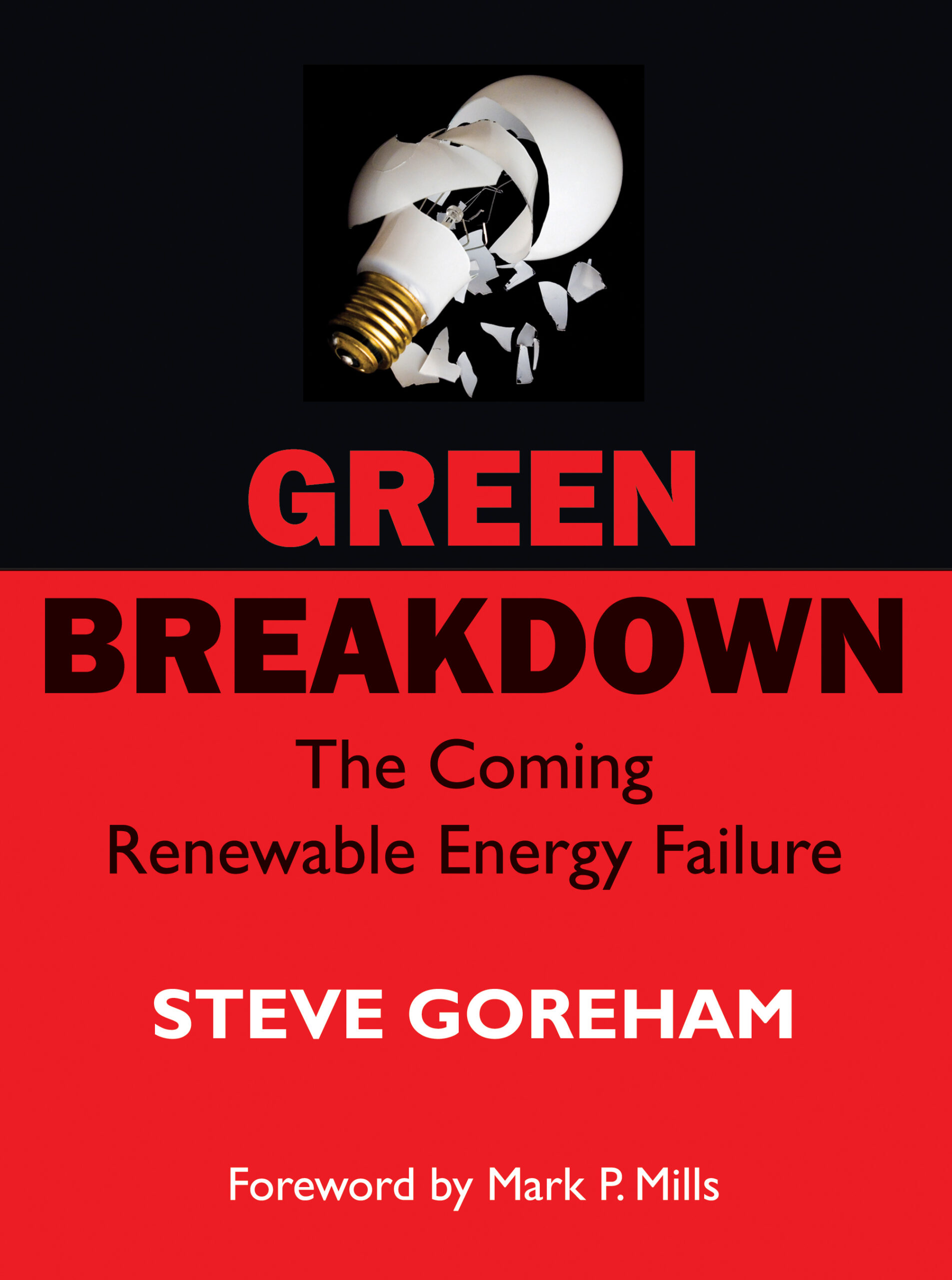
Green Breakdown is a complete discussion of all facets of the proposed renewable transition, including power plants, home appliances, electric vehicles, ships, aircraft, heavy industry, carbon capture and storage, and the hydrogen economy. Charts, graphs, and references to numerous studies are used to support the analysis. At the same time, the large collection of cartoons, images, and quotes grabs the attention of the reader.
From the Introduction:
…“An engineer who attended one of my recent presentations told me his wife had returned her electric vehicle (EV) to Tesla, the manufacturer.
Europe’s Crisis: Blame Green Energy Policy
By Steve Goreham -- June 28, 2023“The lesson from Europe is that reliance on wind, solar, and imported natural gas is expensive and risky energy policy. If you experience a low-wind year, a cold winter, an embargo, or a war, you can’t turn up the wind and solar.”
The year 2022 was an energy disaster for Europe. Citizens and businesses suffered from astronomical prices for natural gas and electricity, sky-high home energy bills, shuttered industrial plants, and bankrupt companies. Observers have blamed COVID-19 supply chain disruptions and the Russian invasion of Ukraine, but Europe’s green energy policies was the elephant in the room.
For the last two decades, closures of traditional power plants and renewable energy policies made European countries highly dependent upon a combination of intermittent wind and solar sources and natural gas. More than 100 nuclear plants had closed or were scheduled to close, including 30 in Germany and 34 in the United Kingdom.…
Surging New England Energy Prices: No Surprise
By Steve Goreham -- May 30, 2023“New England home heating and electricity prices are on the rise with no end in sight. Consumers paid record high energy bills last winter, even though the winter was not unusually cold. Shortages of natural gas and green energy policies will drive New England prices higher and raise the chance of electricity blackouts.”
Residential energy bills in New England this year were the highest in history. The combination of electricity and natural gas heating bills exceeded $1,000 per month for an average-sized house in Massachusetts, even though winter temperatures in New England were warmer than average.
Eighty percent of homes in New England, which includes Connecticut, Maine, Massachusetts, New Hampshire, Rhode Island, and Vermont, heat with fuels from oil and gas. The hydrocarbon fuel share of home heating is natural gas (39%), fuel oil and kerosene (33%), and propane or liquid petroleum gas (8%).…