Climate Change and Energy: World Leaders in Turmoil
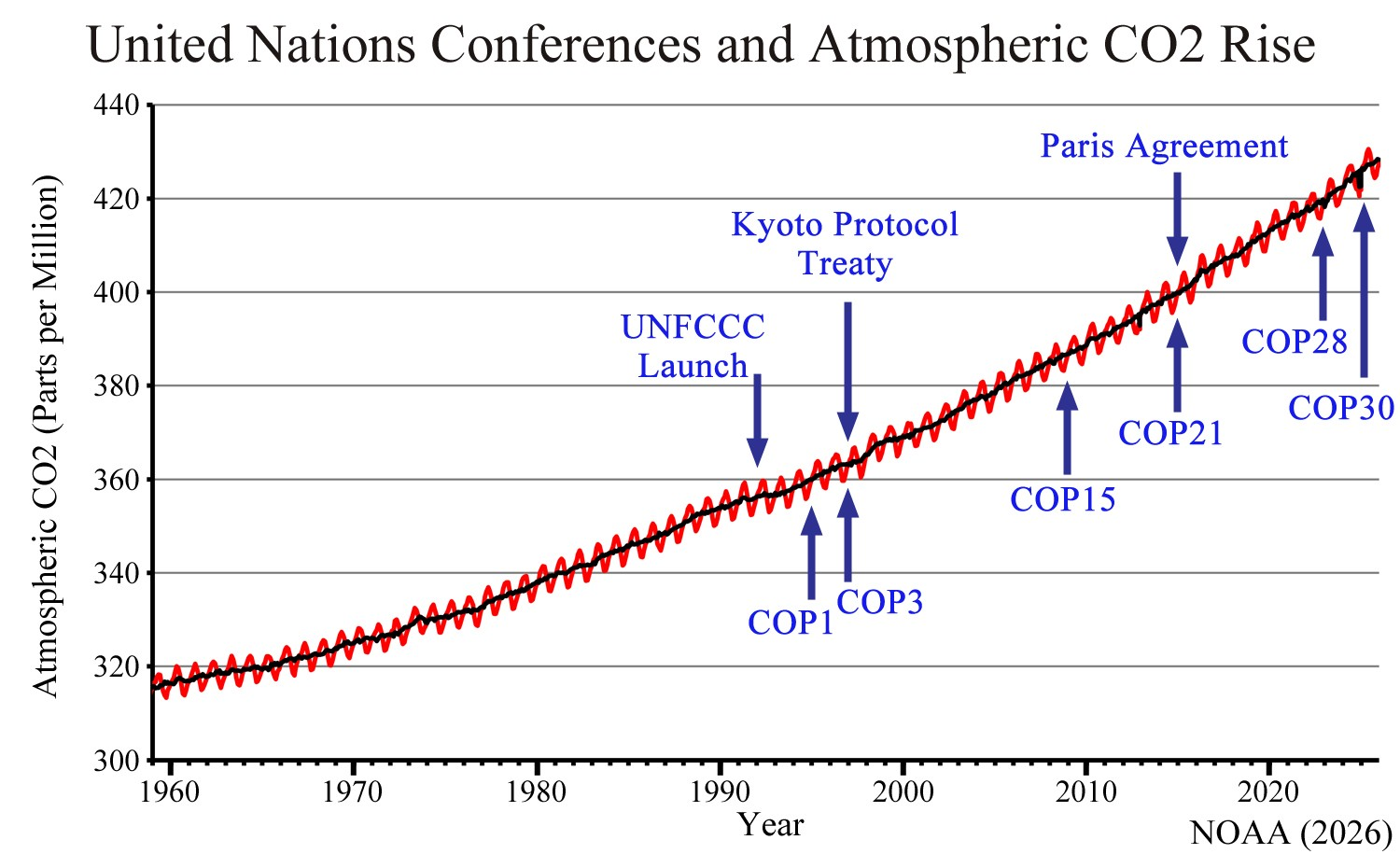
By Steve Goreham -- February 9, 2026“There is no evidence that UN COP meetings and more than $10 trillion spent on renewables over the last 30 years have affected the climate. The average atmospheric carbon dioxide concentration, which is blamed for global warming, has been rising over the last 50 years without any change to the trend.”
World leaders are in turmoil. For 30 years, the United Nations, World Economic Forum, and International Energy Agency, among business and political leaders called for a shift from hydrocarbon fuels to renewable energy. Thousands of laws were enacted to try to force a net zero energy transition. But it’s now clear that green energy is unable to meet the needs of growing developing nations or support the artificial intelligence (AI) revolution in advanced nations.
Since the founding of the United Nations Framework Convention on Climate Change (UNFCCC) in 1992, the UN has led efforts to reduce carbon dioxide emissions to try to fight human-caused global warming. Delegates from more than 180 nations meet at the annual UN Conference of the Parties (COP) to discuss climate action, with recent COP attendance exceeding 50,000 attendees.
But there is no evidence that UN COP meetings and more than $10 trillion spent on renewables over the last 30 years have affected the climate. The average atmospheric carbon dioxide concentration, which is blamed for global warming, has been rising over the last 50 years without any change to the trend.
The World Economic Forum (WEF), a forum of business leaders established in 1971, states: “business should not only create economic value but also serve society and the planet.” At the WEF Sustainable Development Impact Summit in 2020, more than 4,500 leaders called for a “Great Reset for Sustainable Development,” committing to reach Net Zero by 2050 or sooner.
Environmental, Social, and Governance (ESG) was established in 2004 by the UN as a framework to evaluate a company beyond traditional financial metrics. Of high importance in ESG is a firm’s efforts to reduce greenhouse gas emissions and support policies to fight climate change.
But net zero policies cannot support the energy needs of growing developing nations. Also, the rise of artificial intelligence drives a huge need for electrical power in advanced nations that cannot be supplied by intermittent green energy sources. Businesses and political leaders now realize that Net Zero and ESG are not the keys to the future.
Today, more than 6,500 coal-fired power plants operate with more than 1,000 new plants in planning or under construction. Coal plants provided 34% of world electricity in 2024, the leading source. Leaders call for an end to coal-fired power, but coal consumption grew to an all-time high in 2024. Still, 700 million people still do not have access to electricity and about two billion suffer blackouts or brownouts every other day.
In 2021, Fatih Birol, Executive Director of the International Energy Agency (IEA), said, ”If governments are serious about the climate crisis, there can be no new investments in oil, gas, and coal from now—from this year.” But last year the IEA World Energy Outlook predicted that oil demand would continue to increase to 2050 and that gas consumption would increase 30% by 2050 in their “current policies scenario.”
U.S. Energy Secretary Chris Wright recently pointed out that each of the billion people in the developed world uses about 13 barrels of oil per year, while a developing nation resident uses only about three barrels per year. The US and Europe have one or two vehicles per person compared to less than one vehicle for every ten people in Africa or India. Residents of wealthy nations use ten times the plastic used by people in developing countries. Developing countries will propel the demand for hydrocarbon fuels to better their standards of living.
The AI revolution now drives the need for electric power in wealthy nations. The US and China are competing for AI dominance and Europe wants to join the battle. Data center construction is skyrocketing to support AI. Amazon, Google, Meta, and Microsoft invested over $380 billion last year on AI infrastructure, a total larger than the gross domestic product of more than 140 nations.
Larry Fink, co-chair of the WEC and CEO of BlackRock, the world’s largest investment fund, said at the WEC conference last month, “You cannot rely solely on intermittent sources like wind and solar. You need dispatchable power because these data centers cannot simply turn on and off.” AI data centers are being powered by natural gas and in some cases nuclear power.
Leading firms pledged to become Net Zero, but the AI revolution is shattering those plans. In 2020, Google announced a goal to operate on carbon-free energy by 2030. But in 2024 Google admitted their emissions rose 48% over the last four years due to AI-driven services.
In 2020, petroleum company BP launched a $200 million “environmentally friendly” public relations campaign. The firm rebranded itself as “Beyond Petroleum,” pledging to reduce oil and gas production 40% by 2030 and to boost investments in renewable energy. Shell, ExxonMobil, and Chevron all announced plans to invest in renewables or green technologies such as carbon capture and storage.
But oil and gas firms found that renewables couldn’t make money, even with government subsidies. Returns on renewable projects were about six percent while oil and gas project returns were over ten percent. BP and Shell scaled back their renewable goals and investments in 2025.
In 2020, Larry Fink declared that he intended to use the trillions of US dollars managed by BlackRock to address global warming. Almost every major financial institution pledged to reduce emissions. ESG became a defining feature of Wall Street investing. More than 100 companies joined Climate Action 100+ to focus on reducing emissions globally. The UN-convened Net Zero Banking Alliance was established in 2021 and quickly grew to 140 financial institutions.
The Great Reversal
But a conservative backlash attacked financial industry support for ESG and climate action. Republican legislatures in the US introduced more than 100 bills to penalize financial companies that supported ESG practices. Republican state treasurers withdrew money from BlackRock.
As a result, climate and ESG efforts in the financial industry have collapsed. After Donald Trump’s re-election in November 2024, almost every US financial institution pulled out of the Net Zero Banking Alliance, causing the group to fold. Dozens of firms left Climate Action 100+. European firms also pulled back from climate commitments.
The shutdown of US climate policies during President Trump’s second term have devastated the global climate movement. The US has withdrawn from the Paris Climate Agreement and the UNFCCC and cut funding for climate organizations. A climate tax on shipping proposed by the International Maritime Organization was halted by US and China opposition. The ending of US subsidies for wind, solar, and electric vehicles heavily impacted those industries.
Microsoft founder and climate activist Bill Gates authored the book How to Avoid a Climate Disaster in 2021. But last fall he changed his position. In a memo to COP30, he criticized the climate community for their “doomsday outlook” and focusing too much on “near-term emissions goals,” stating that “our chief goal should be to prevent suffering, particularly for those in the toughest conditions who live in the world’s poorest countries.”
In addition to US Republican opposition, other political parties withdrew support from Net Zero. Reform UK, which is leading in UK polls, coined the phrase “Net Stupid Zero.” Alternative für Deutschland, the number two party in Germany, calls wind turbines “windmills of shame.” Both the National and the Liberal parties in Australia scrapped their support for Net Zero last fall, concerned with green energy costs.
Conclusion
World leaders are pulling back from climate hysteria and demands for net zero energy. It’s time to return to sensible energy policy and to adapt to climate change, as humanity has done for all of history.
———
Steve Goreham is a speaker on energy, the environment, and public policy, and author of four books, including Green Breakdown: The Coming Renewable Energy Failure.
Editor’s Appendix: Goreham Posts at MasterResource
A mark of a true scholar is how his or her writings and conclusions stand the test of time. Steve Goreham’s writings for MasterResource for more than a decade read well today. His books and illustrations on climate/energy issues are excellent. And with his editorials in the Wall Street Journal (see here, here, and here) and other leading publications, this ‘talented amateur’ is running circles around leading academics on the same issues.
Rejecting Climatism: Trump Withdraws from UNFCCC and 66 International Organizations (January 14, 2026)
Environmental Groups Urge Congress to Ban Data Centers (December 17, 2025)
A Nuclear Resurgence, But Major Obstacles Remain (November 20, 2025)
Steeper Road for Zero-Emissions Vehicles (July 23, 2025)
Net Zero’ Is Collapsing in U.S. States (June 16, 2025)
Time to Defund Climate Models? (April 29, 2025)
US Military Exits Climate Change After Wasteful Decade (April 2, 2025)
Trump Truth Bombs ‘Green’ Energy (Five EOs) (January 27, 2025)
Wind and Solar Are Fragile (December 3, 2024)
Scientists Haven’t ‘Saved’ the Ozone Layer (November 13, 2024)
No Gov. Inslee, Repeal of Washington State’s Climate Law Won’t Hurt the Climate (July 31, 2024)
New US-EU Methane Rules Won’t Affect Temperatures (July 9, 2024)
Winter Without Your Gasoline Car? (May 15, 2024)
Exploding Energy Prices in California (March 12, 2024)
Electric Power vs. Green Goals (February 27, 2024)
California’s Electric Truck Mandate: 19 States Sue (November 21, 2023)
Green Hydrogen Needs Vast Subsidies (October 19, 2023)
Europe: AI Development or Net Zero? (September 10, 2023)
Carbon Language in Global Error (September 5, 2023)
“Green Breakdown: The Coming Renewable Energy Failure” (August 22, 2023)
Europe’s Crisis: Blame Green Energy Policy (June 28, 2023)
Surging New England Energy Prices: No Surprise (May 30, 2023)
The Practical Impossibility of Large-Scale Carbon Capture and Storage (May 2, 2023)
Green Energy: Greatest Wealth Transfer to the Rich in History (February 21, 2023)
New England Curtails amid World Natural Gas Boom (April 9, 2019)
‘Sustainable’ Fuels Unlikely to Replace Hydrocarbons for Air Travel (January 2, 2019)
100 Percent Renewables—Poor Policy for Ratepayers (October 29, 2018)
Protesters Aren’t Stopping US Pipeline Network Growth (June 27, 2018)
The Myth of Dangerous Acid Rain (in light of Hawaii’s Kilauea volcano) (May 23, 2018)
Electrification’: The Road to Higher Energy Prices (January 3, 2018)
Tax Bill Attacked for Loss of Electric Car Subsidy—But Most Americans Don’t Want Electric Cars (November 20, 2017)
Are US Vehicle-Mileage Standards Obsolete? (November 8, 2017)
Shale Shock: A New, Better Energy World (September 30, 2015)
Stressing the Grid: From Interventionism to Blackouts (April 24, 2014)
Thankfully Wrong: World Agriculture Booms in Face of Dire Predictions (November 29, 2013)
Don’t Divest, Educate–An Open Letter to American Universities (June 11, 2013)
Revisiting Climategate as Climatism Falters (June 6, 2013)
Climategate’s Fifth Anniversary: Grubered Science (revisiting a controversy) (November 19, 2011)
Larry “Which Way Is The Wind Blowing Today” Fink rivals Chuckie Schumer as the world’s biggest blowhard windvane.
Fossil fuels just cannot compete in the future against renewable energy. Our futures depend on a stable climate rather than the kaos that fossil fuels does to us.
https://www.juancole.com/2026/02/australia-wholesale-electricity.html
Quote:
****from $104 AU/MWh in Q3 2025 to just $37 AU/MWh in Q4 2025 (approximately 2.6 US cents per kilowatt hour). This is the lowest wholesale price across all of Australia, and it happened while demand actually increased by 1.2% to record levels.****unquote
Fossil fuels cannot compete. South Australia has gone from a mostly coal region to a mostly renewable energy region in about 10 years. By 2027, South Australia has plans to be at 100% RE.
Mr. Green: I disagree. Wind and solar are just a government play. In a free market, fossil fuels dominate over dilute, intermittent, fragile, land-and-transmission-intensive renewables.