Search Results for: "Ken Lay"
Relevance | DateRepublicEn or RepublicEnron? (Bob Inglis’s futile crusade for carbon taxation)
By Robert Bradley Jr. -- November 17, 2014 No CommentsVoters blasted climate alarmism at the ballot box earlier this month, just as South Carolina Republicans voters fired Rep. Robert Inglis for his climate alarmism back in 2011. Yet, Obama-like, the now head of Energy and Enterprise Initiative at George Mason University has launched a new website, republicEn.org and written an inaugural blog post about the post-election prospects for enacting a carbon tax.
In trying to sell Republicans on a carbon tax to reduce U.S. carbon dioxide emissions, Inglis insists on calling himself a Republican and free-marketer. Since 2012, his EEI has engaged in ” a nationwide public engagement campaign promoting conservative and free-enterprise solutions to energy and climate challenges.” Wiki also describes his work “to build support for energy policies that are true to conservative principles of limited government, accountability, reasonable risk-avoidance, and free enterprise.”…
Continue ReadingJohn Hofmeister’s War on Oil (ethanol and methanol for the masses?)
By Robert Bradley Jr. -- October 13, 2014 No Comments“In terms of affordability, availability and scalability – methanol and ethanol are the best prospects to [displace oil in transportation] quickly.”
– John Hofmeister, quoted in John Holeywell, “Q&A: He Ran Shell Oil Co. – and He Thinks We Use Too Much Crude,” Houston Chronicle, September 19, 2014.
Milton Friedman once opined: “The two greatest enemies of free enterprise in the United States … have been, on the one hand, my fellow intellectuals and, on the other hand, the business corporations of this country.”
Enter T. Boone Pickens, crony capitalist extraordinaire. Enter John Hofmeister, former president of Shell Oil Co. (2005–2008), the Houston-based U.S. subsidiary of Royal Dutch Shell. [1]
Hofmeister maliciously titled his signature book, Why We Hate the Oil Companies: Straight from an Energy Insider.…
Continue ReadingEx-Im Bank Cronyism: Remember Enron’s Bad Investments
By Robert Bradley Jr. -- June 18, 2014 2 Comments“Enron was a political colossus with a unique range of rent-seeking and subsidy-receiving operations. Ken Lay’s announced visions for the company—to become the world’s first natural-gas major, then the world’s leading energy company, and, finally, the world’s leading company—relied on more than free-market entrepreneurship. They were premised on employing political means to catch up with, and outdistance, far larger and more-established corporations.
– R. Bradley, “Enron: The Perils of Interventionism,” EconLib, September 3, 2012.
A debate is currently playing out over the future of the Import-Export Bank, which comes up for Congressional reauthorization this September. In “End Corporate Welfare? Start With the Ex-Im Bank,” Tim Phillips, president of Americans for Prosperity, a free-market advocacy group, pin-pricked the notion that small business was the beneficiary of taxpayer-guaranteed loans.…
Continue ReadingOhio SB 310: Energy Users Best the Cronies (GE, AWEA, etc.)
By Kevon Martis -- May 30, 2014 3 Comments“But the truth is that Ohio’s renewable energy mandates have largely benefited only one group: entrenched monopoly fossil utilities like AEP, Iberdrola, and corporate behemoths like GE.”
Senate Bill 310’s attempt to freeze Ohio’s renewable energy mandate has elicited the typical partisan howls from Ohio’s green energy profiteers. They have been quick to paint the supporters of SB310 as slavish supporters of the much maligned Koch Brothers, FirstEnergy or other “dark fossil corporate profiteers”.
Curiously, these environmental group’s normally exquisitely tuned “corporate conspiracy radar” appears to have developed a massive wind-turbine-sized blind spot.
Consider:
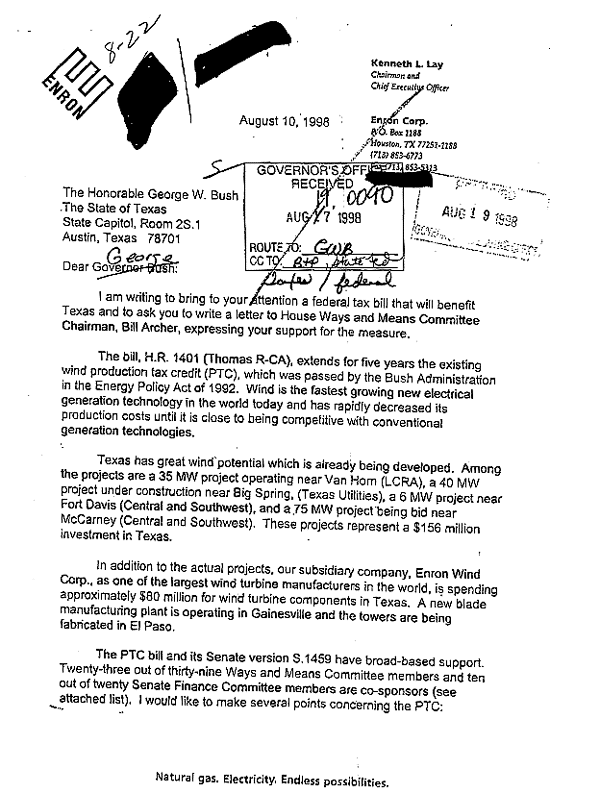
- In 1998 it was Enron’s Ken Lay who implored George W. Bush to extend subsidies for wind energy. A quick scan of his letter reveals talking points that today could easily be mistaken for the Ohio Sierra Club: “Wind is the fastest growing new electrical generation technology in the world today and has rapidly decreased its production costs until it is close to being competitive with conventional generation technologies.”