Archive
- January (42)
- February (42)
- March (31)
- April (29)
- May (28)
- June (26)
- July (26)
- August (26)
- September (28)
- October (26)
- November (24)
- December (27)
Classical Energy Thinking: Right on Renewables (intermittency), Not-so-Right on Fossil Fuels (coming exhaustion)
By Robert Bradley Jr. -- December 30, 2009“The winds, turning more mills than ever before, pump water, grind grain, churn, and do a score of little tasks for a surviving domestic industry; but they list not to blow with enough regularity or violence to keep wheels spinning and mills going.”
– Walton Hamilton and Helen Wright, The Case of Bituminous Coal (New York: Institute of Economics/Macmillan, 1926), p. 3.
William Stanley Jevons’s The Coal Question (1865), the book that founded mineral economics, got it right on the limits of renewables for the machine age and the godsend of coal as a superabundant utilitarian energy source.
Previous posts at MasterResource have summarized Jevons’s 19th century wisdom on the primacy of coal (carbon-based energy); the limits of windpower; the limits of hydropower, biomass, and geothermal; and the paradox of energy efficiency.…
Industrial Wind Power: An Old, Tried Failure (the intermittency curse then and now)
By Robert Bradley Jr. -- December 29, 2009Best of MasterResource: 2009
This post orginally appeared (with comments)
on March 4th
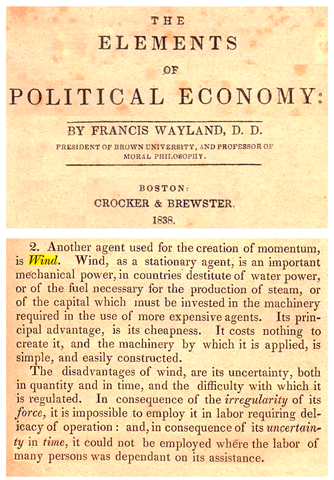
The disadvantage of windpower as a primary energy source has been long recognized. This 1838 textbook described the competitive situation of wind as follows:
William Stanley Jevons also detailed the problems of windpower in his 1865 classic, The Coal Question,…
WSJ’s “Heard on the Street”: Political Energy Down, Market Energy Up Post-Copenhagen (Remembering the risks of Enron’s political capitalism model)
By Robert Bradley Jr. -- December 26, 2009Matthew Curtin’s Heard on the Street in the December 22nd Wall Street Journal, Green Investments Are Being Clouded by Copenhagen, caught my eye. Copenhagen not so much failed as energy reality won. The 19th century British economist W. S. Jevons would have smiled as neo-Malthusian politics fell victim to old fashioned consumerism, economic growth, free trade, and energy economics 101.
Copenhagen also brings into review the risky political capitalism model where profit-making is tied to special political favor rather than underlying consumer demand. Enron’s core business model was tied to rent-seeking, part of the problems that brought down the company in spectacular fashion.
Here is what Mr. Curtin wrote:
…The Copenhagen climate summit will do little to spur further investment in environmental technologies.
That is hardly surprising given the fundamental flaw at the heart of the process: Negotiations to reduce global carbon dioxide emissions were premised on how much of the gas nations produce, rather than what they consume.