Fossil Future: COP 31’s Failure
By Robert Bradley Jr. -- November 19, 2026“The organisers are billing the thirty-first summit as the one where everyone finally gets on with implementation. Thirty-one meetings is a long time to spend getting to the part where you do the thing…. [I]t seems reasonable to ask how much of the last thirty years’ work shows up in the energy accounts, and what the travelling show itself burns along the way.” – Vlado Vivoda (below)
COP 31 in Antalya, Turkey marks the tenth anniversary of the COP 21’s Paris Accord. This (voluntary) international treaty set out to limit the rise in the global average temperature to “well below” 2°C above pre-industrial levels, while pursuing a limit of 1.5°C. Another goal was to achieve net-zero emissions by 2050, with a net reduction of 45 percent by 2030.
So much for aspirations. Politically and otherwise, consumer preference for the best energies will not be denied. The current global market share of fossil fuels is a robust 86 percent, despite decades of government intervention propping up nuclear, wind, and solar in electrical generation. According to AI, this compares to 85–87 percent in 1990 and 86 percent in 2015. So much for ‘energy transformation.’
Reality: James Hansen was Correct
Upon its passage in 2015, the Paris Climate Agreement was called by James Hansen as “a fraud really, a fake…. It’s just worthless words.” He added:
It’s just bullshit for them to say: “We’ll have a 2C warming target and then try to do a little better every five years.” It’s just worthless words. There is no action, just promises. As long as fossil fuels appear to be the cheapest fuels out there, they will be continued to be burned.
A realist, Hansen had more to say about the agreement and “Big Green” lobby behind it:
Watch what happens in Paris carefully to see if all that the leaders do is sign off on the pap that UN bureaucrats are putting together, indulgences and promises to reduce future emissions, and then clap each other on the back and declare success.
Continuing:
Big Green consists of several ‘environmental’ organizations, including Environmental Defense Fund (EDF) and National Resources Defense Council (NRDC), each with $100+M budgets, each springing from high-minded useful beginnings, each with more high-priced lawyers than you can shake a stick at. EDF …was chief architect of the disastrous Kyoto lemon. NRDC proudly claims credit for Obama’s EPA strategy and foolishly allows it to migrate to Paris. [1]
Yet the energy transition has been demoted to energy addition (Daniel Yergin) and now energy duplication. Think rising energy prices from climate mitigation policy that is trying to pass itself off as energy affordability.
In “Thirty Years of Climate Pledges and a Record Year for Fossil Fuels” (November 11, 2026), Vlado Vivoda, PhD provided a ten-year true-up to COP 31 in regard to COP 21. “Prominent commentators have been making fun of the COP circus in Antalya,” he began.
It deserves it. About 68,500 people registered for the fortnight, according to the Associated Press, with close to 25,000 more on hand to keep the venue running, and local officials have spent the year promising Antalya its best November ever and roughly US$2 billion in foreign currency. The organisers are billing the thirty-first summit as the one where everyone finally gets on with implementation. Thirty-one meetings is a long time to spend getting to the part where you do the thing. Before the delegates announce what they intend to do next, it seems reasonable to ask how much of the last thirty years’ work shows up in the energy accounts, and what the travelling show itself burns along the way.
Vlado Vivoda continued:
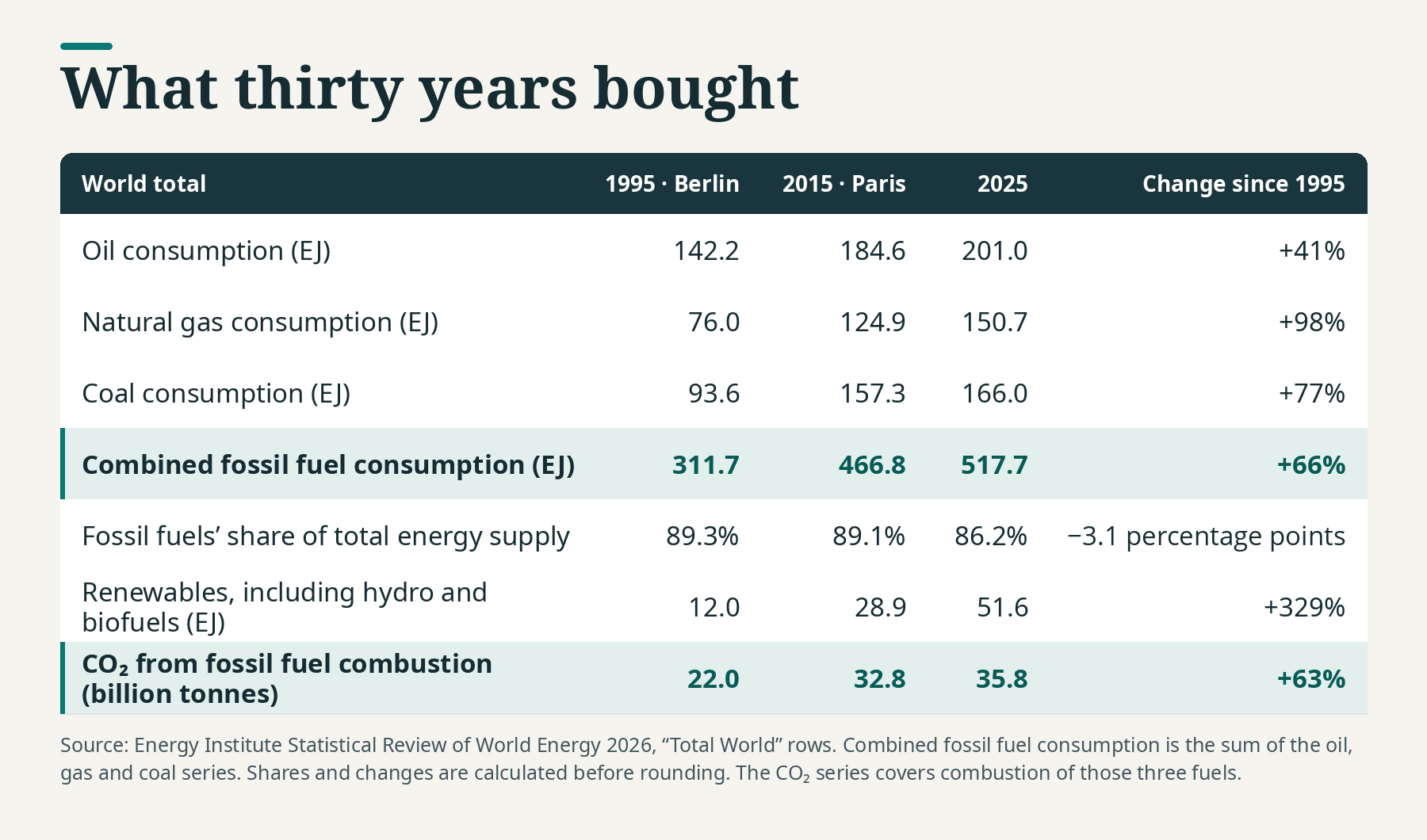
I went back to the Energy Institute’s Statistical Review of World Energy and pulled the global figures for 1995, when the first COP met in Berlin, 2015, when the Paris Agreement was adopted, and 2025, the latest full year in the workbook. Here is the figure that stopped me. The world uses 206 exajoules more fossil energy per year than it did when COP began. That increase alone is larger than the world’s entire annual oil consumption today.
Continuing,
The falling fossil share is real, albeit tiny: a drop of only 3.1 percentage points. So is the growth in renewables. Since Paris, the world has added about 23 exajoules of annual renewable energy supply and 51 exajoules of annual fossil fuel consumption, more than two units of new fossil energy for every unit of new renewables. The denominator grew fast enough for the fossil share to fall while oil, gas and coal each reached a new high in the workbook.
Conclusion
The emissions reductions prescribed by the Paris Accord are busted–and the gap grows with each passing day. The tiny decrease in total carbon dioxide reductions in 2026 came from unusual factors. And what is coming out of COP 31? Little more than a proposal by the host country Turkey to increase electricity’s share of global final energy demand to 35 percent by 2035 compared to about 25 percent today.
COP 31 has been overtaken by politics. More than 100 fossil fuel companies or groups are there, making sure the business opportunities and government subsidies flow the way of their 86 percent market share. [2] Fossil future it is, a good thing to facilitate adaptation in a new phase of climate public policy.
[1] Hansen’s realism toward renewable energy is an identified reason for the futility of the Paris Accord. “Suggesting that renewables will let us phase rapidly off fossil fuels in the United States, China, India, or the world as a whole is almost the equivalent of believing in the Easter Bunny and Tooth Fairy.” he complained.
[2] Vlado Vivoda noted: “Kick Big Polluters Out counted almost 1,800 fossil fuel lobbyists in Baku, more than the combined government delegates of the ten most climate-vulnerable countries, and 1,602 in Belém, roughly one participant in 25 and two-thirds more than the 1,061 delegates sent by those ten countries. Only Brazil’s own delegation was larger.”