Junk Academic Climate/Energy Articles: A Sampling
By Robert Bradley Jr. -- August 10, 2026“Economic efficiency and societal well-being demand that a slew of Marxist-Socialist-Progressive Left professors get real jobs in the private sector serving consumers. To go from Net Zero protagonists to Net Positive producers. In their absence, Internet-AI learning can better serve students….”
It is painful to read through the (far-too-many) academic papers relating to climate change, particularly in the social sciences. Prominent climate journals (AI overview) include:
- Global Environmental Change: Focuses on human and policy dimensions of global environmental change.
- Energy Research & Social Science (ERSS): Examines the intersection of energy systems and society, including behavior and policy.
- Climate and Development: Focuses on qualitative, interdisciplinary studies regarding climate policy, adaptation, and development.
- Environmental Politics: Focuses on the policy, political, and governance aspects of environmental change.
- Weather, Climate, and Society (WCAS):
Even climate alarmist Chris Mooney, previously at the Washington Post and now at the University of Virginia, raises questions.
By this metric, annual climate science studies now number over 15,000. And the chart below is the result of a fairly conservative method for searching the Web of Science database for studies. You can get a much larger total if you search through more detailed article abstracts instead of just article titles, for instance (title searches comprise a key part of the approach shown below).
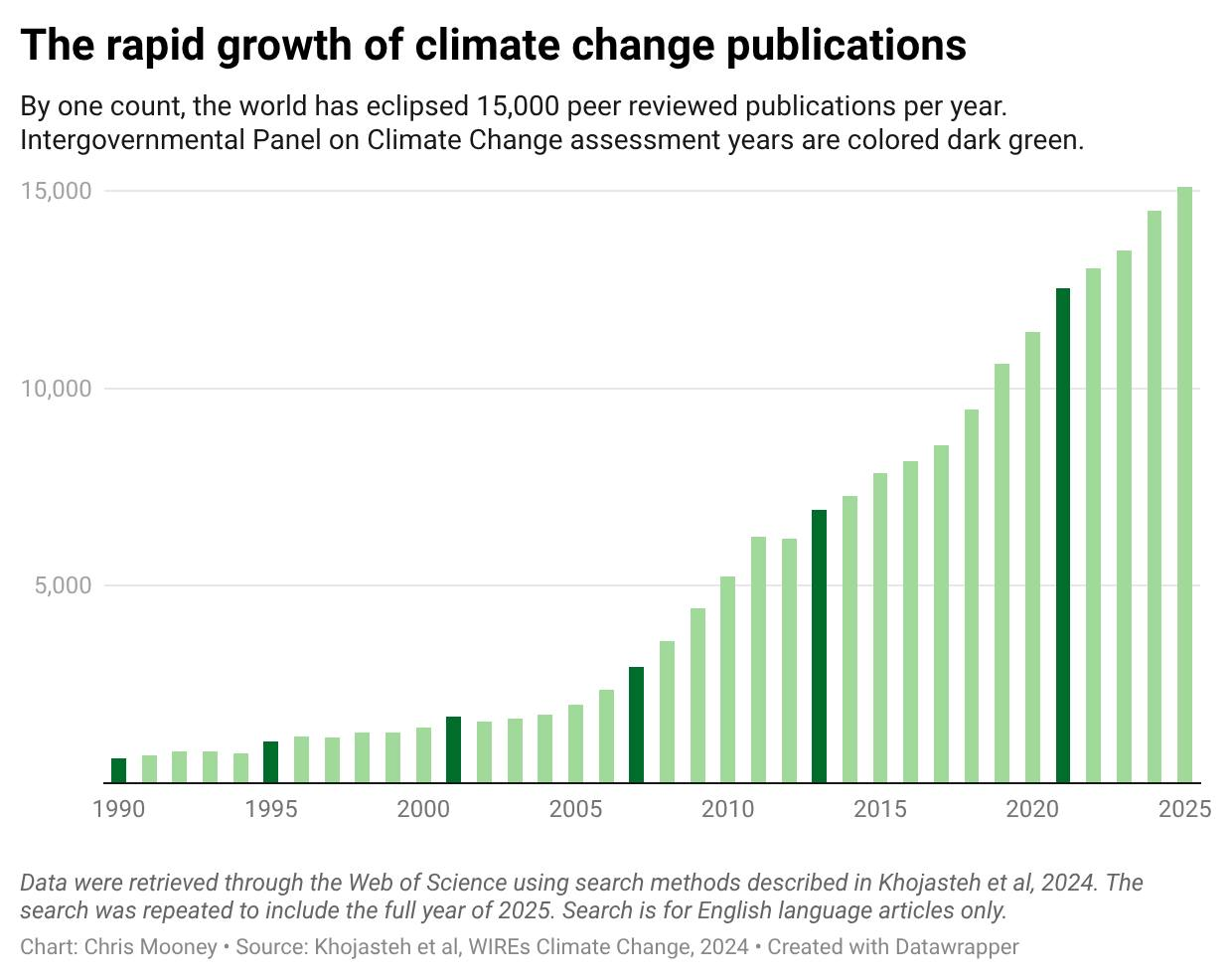
And ask yourself: how many hundreds if not thousands of published, peer reviewed articles were based on the discredited, abandoned climate model scenario RCP 8.5? The IPCC backfire has put much of the above literature in disrepute and limbo–and regulations based on RCP 8.5 are now in legal jeopardy.
Roger Pielke Jr. has followed this history, where an implausible scenario was turned into a base case, resulting in exaggeration and gloom-and-doom prognosis. “It is important that the community understands how the RCP mess came about,” Pielke concluded, “and take steps to ensure that it does not happen again.”
Read and Wonder
Here are some representative articles, with self-descriptions:
Fossil Fuels, the Ruling Class, and Prospects for the Climate Movement – Kevin A Young
The US fossil fuel industry is vulnerable to opposition from other sectors of the ruling class. Non-fossil fuel capitalists might conclude that climate breakdown jeopardizes their interests. State actors such as judges, regulators, and politicians may come to the same conclusion. However, these other elite actors are unlikely to take concerted collective action against fossil fuels in the absence of growing disruption by grassroots activists.
Do expectations of fossil fuel owners matter? – Rutger Lazou
To avoid the disastrous effects of climate change, a rapid and drastic transition toward a low-carbon society and economy is required. This transition imposes significant transitional losses on some agents given the benefits they can no longer realize. In economic terms, it leads to the stranding of their assets.
Fossil fuel divestment for the climate: will next generations change institutions? – Deborah de Lange and Olaf Weber
Our institutions must adapt in the face of a disastrous climate crisis, but who will make this happen? This research extends institutional theory and incorporates pro-environmental behavior literature to consider whether and how the interests and motivations of the next generations might shape existing investment institutions.
Rethinking the Growth Mantra: An Exploration of the Post-Normal World of Declining Conventional Fossil Energy – Terry Berg
Globally, the production of all conventional fossil sources of energy will have peaked or be near-peaking by 2025. When this occurs, this lifeblood of the modern, complex, global civilizations will ensure that the lives of all humans begin an energy transformation characterized by growing climate disruption, increasing fossil energy production costs and corresponding economic impacts. Those who will experience the greatest transition (or shock) will be ones who currently have the greatest invested dependency in fossil energy.
The environmental counter-history of liberalism: A formidable challenge – Fred Matthews
In the view of the Marxist philosopher Domenico Losurdo, liberalism is ‘the most dogged enemy of freedom’. This surprising statement runs contrary to the received wisdom among liberal thinkers. Losurdo and other ‘counter-historians’ of liberalism are very effective at exposing the historical atrocities that liberal states have committed, and which have been supported by liberal philosophers – including slavery, racism, genocide, and the subjugation of the working class…. Liberalism-in-practice is currently implicated in various forms of environmental degradation and resulting structural violence against disempowered groups.
Final Comment
There are far too many professors and dead-end, misleading articles that flow from false assumptions and flawed worldviews. Economic efficiency and societal well-being demand that a slew of Marxist-Socialist-Progressive Lefties professors be dismissed from academia and get real jobs in the private sector serving consumers. To go from Net Zero protagonists to Net Positive producers. (Flip hamburgers if nothing else.) Internet learning can better serve students by presenting the major figures on each side of the debate (yes, climate science is unsettled and there are multiple viewpoints).
The most efficient remedy for spoiled and entitled is a little taste of hunger.