U.S. EPA’s Energy Exceptionalism (CO2 freedom)
By Robert Bradley Jr. -- September 18, 2026This week, the U.S. Environmental Protection Agency released a final rule:
EPA Finalizes Repeal of 2024 Power Plant Regulations, Delivering $300+ Billion in Savings, Proposes Repeal of All Remaining Greenhouse Gas Emissions Standards for Power Plants
that will be followed by a public hearing 15 days after publication in the Federal Register, followed by a 45-day public comment period.
The press release triumphantly stated:
Trump EPA delivers reliable and affordable energy in the largest power sector deregulatory action in U.S. history
Released for maximum effect at the G20 Summit in Houston, Texas, the press release continued:
… Continue Reading… U.S. Environmental Protection Agency (EPA) Administrator Lee Zeldin announced the repeal of the majority of the Biden administration’s greenhouse gas requirements for U.S. power plants, an action the agency projects will save $310 billion, and proposed rescinding every remaining greenhouse gas standard for the power sector.
Why ‘Feel Good’ Climate Activism?
By Robert Bradley Jr. -- September 17, 2026Sam Belfied in his essay, “Climate Activism: ‘It Made Me Feel Like a Good Person’” (August 19, 2026), has a number of interesting insights on the motivations of climate campaigners given the intellectual case that their cause is both futile and wasteful. And ecologically damaging (think wind and solar industrialization). Excerpts follow verbatim; footnotes can be found in the original.
The following commentary and research findings suggest that climate ideology and activism are psychological compensatory responses to painful, emotional, subjective, and even existential aspects of the self. Specifically, the material suggests a deeper and collective psychological malaise, of which anxiety and distress about climate change are an expression, not the root cause….
The climate movement involves guilt, self-loathing and seeking redemption
In discussing the emotions motivating climate activists, commentators have proposed ‘guilt,’ ‘self-flagellation,’ ‘sin,’ ‘self-loathing’ , ‘conscience’, and seeking ‘atonement’ and ‘redemption.’…
Continue ReadingEnergy Future: CO2 Enrichment Ahead (de-decarbonization)
By Robert Bradley Jr. -- September 16, 2026“There is no renewables ‘transition’ – ONLY addition.” (below)
The much-hyped “energy transition” has predictably failed. Grant Lukies presented the chart below and reported on social media:
For those of you paying attention – still no ‘transition’ evident whatsoever (to August 2025). 33 years of IPCC stewardship and panic and $billions spent and absolutely zero downward trend in slope of the curve.
THIS is THE failed KPI of alarmist catastrophism writ large. There is no renewables ‘transition’ – ONLY addition.
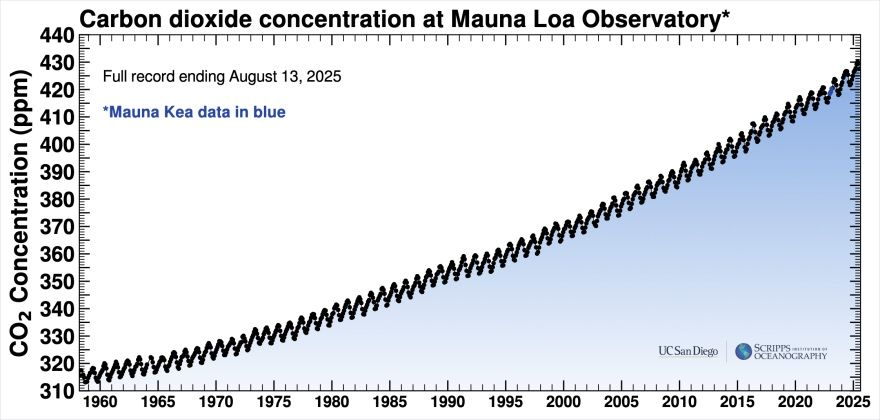
Is this bad news? Hardly. The plants rejoice as CO2 enrichment continues. A greener Planet Earth is surely better than wind, solar, and battery industrialization from all points of view.
Remember what Daniel Yergin concluded in The New Map: Energy, Climate, and the Clash of Nations (2020), p. 422:
… Continue ReadingAs they grow, wind and solar and EVs will need ‘big shovels’ to meet their increasing call on mined minerals and land itself.