Thirty Failed Climate Forecasts (optimism please)
By Robert Bradley Jr. -- January 2, 2026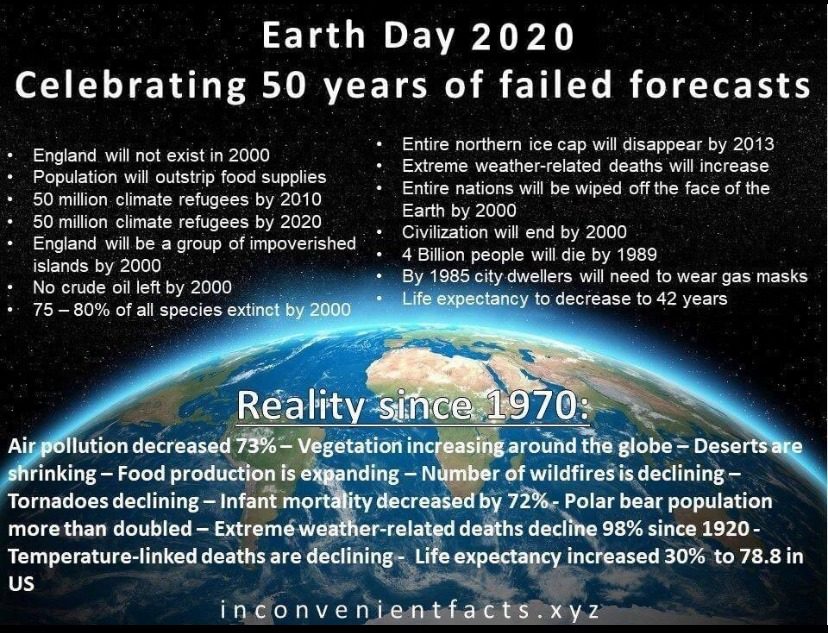
Martin Ecclestone on social media (November 4, 2025) usefully provided a historical review of climate exaggeration. “Educate yourself,” he began. “Uninformed personal opinions don’t change facts.”
Here’s a list [30] of the major climate-change impacts that climate scientists predicted and that have already eventuated (observed and documented in the scientific literature and major assessments). I’ve kept each item short — if you want, I can expand any item with dates, regions, or citations.
1. Global mean surface temperature rise (planet warming).
2. More frequent and/or more intense heatwaves (land).
3. Ocean warming (upper ocean and deep ocean temperature increase).
4. Global sea-level rise (mean sea level increase).
5. Melting of glaciers and mountain ice (glacial retreat).
6. Loss and thinning of Arctic sea ice (decline in extent and volume).
7. Ice-sheet mass loss (Greenland and Antarctica contributing to sea-level rise).
8. Earlier spring phenology (earlier leaf-out, flowering, snowmelt).
9. Changes in precipitation patterns (shifts in regional rainfall amounts).
10. Increased frequency/intensity of heavy precipitation and flood events.
11. Regional increases in drought frequency and/or severity (in many areas).
12. Increased wildfire frequency, extent and fire-weather conditions.
13. Ocean acidification (declining seawater pH from CO₂ uptake).
14. More frequent and severe coral bleaching and mass coral-mortality events.
15. Shifts in species’ geographic ranges (poleward/upward migrations).
16. Changes in timing of biological events (mismatches in food webs; e.g., breeding vs. food peaks).
17. Increased tree mortality and forest dieback linked to heat, drought and pests.
18. Permafrost thawing and associated ground instability/greenhouse-gas release.
19. Increased coastal erosion and more frequent coastal flooding (storm surge + higher baseline sea level).
20. Salt-water intrusion into coastal aquifers and soils (salinization).
21. Increased risk of glacial-lake outburst floods (new/proliferating glacier lakes).
22. Changes in ocean circulation and regional oceanographic patterns (observed changes and signals).
23. Changes in the distribution and seasonality of vector-borne diseases (e.g., mosquitoes).
24. Observed impacts on crop yields and growing seasons (regional increases and decreases).
25. Observed impacts on human health (heat-related illness and mortality, some flood-related health impacts).
26. Observed economic impacts and damage to infrastructure from climate-related extremes.
27. Losses of coastal wetlands and mangroves in some places (linked to sea-level rise and human pressure).
28. Increase in megafaunal/animal population stress and localized extinctions at vulnerable sites/ecosystems.
29. Documented changes in fisheries (range shifts, productivity changes, local declines).
30. Increased frequency of compound events (two or more hazards occurring together or in sequence, e.g., heat + drought, flood + landslide).
Documentation
Notes on scope and confidence
• The items above are major, widely documented impacts that were predicted by climate science and have now been observed. Confidence and attribution vary by impact and by region — for many items (e.g., global warming, sea-level rise, Arctic sea-ice loss, glacier retreat, ocean warming, more intense heatwaves, ocean acidification, coral bleaching, increased heavy precipitation) the scientific assessments assign high to very high confidence that human greenhouse-gas emissions are the primary cause.
• Some impacts (e.g., exact changes to regional precipitation patterns, changes in some disease distributions, or economic impacts) are more context-dependent and have greater regional variability and uncertainty.
• This list is extensive but not literally every single local or indirect effect — many local, ecosystem-specific and socioeconomic consequences branch from the entries above.
Key authoritative sources summarizing observed impacts (for deeper reading): IPCC assessments and major agencies such as NASA and NOAA document and attribute these observed changes.
I read and recommend about 60 climate and energy articles each week.
https://honestclimatescience.blogspot.com/
This was the best article of the week.
Climate change is best described as a 50 year series of wrong, gloomy climate predictions.
Keep up the good work in 2026.
No credible scientific source has predicted that climate change will specifically kill “your” individual pet dog. But I am expecting to hear that prediction in 2026.