Blue States. High Rates ($0.55/gallon premium)
By Robert Bradley Jr. -- August 19, 2026Ed. Note: The post reproduces the introduction and conclusion of a new report by the Institute for Energy Research (IER), The Pacific Premium: Why Gasoline Costs More in Democratic-Controlled States. The bottom line: in Democratic-controlled states, state fuel taxes, carbon mandates, and regulations add on average 55 cents per gallon at the pump.
“For policymakers, that is the actionable point: the levers that explain the gap are specific and identifiable, and the largest of them, state fuel taxes and transportation carbon taxes, pass through to consumers nearly dollar for dollar.”
When gasoline prices climb, drivers everywhere start asking the same question: what’s really behind the pain at the pump? The answers are rarely simple. Shifting global oil markets, OPEC decisions, wars and sanctions disrupting supply, refinery outages, pipeline constraints, seasonal weather and demand swings can all play a role. Yet one pattern stands out clearly in the data. Gasoline is more expensive in Democratic-controlled states, and over the past five years prices have risen faster there.
In early 2026, states with unified Democratic control (the governorship plus both legislative chambers) averaged $3.69 per gallon, while unified Republican states averaged $3.14 per gallon, a gap of $0.55 per gallon. Averaged over our full 2017–2026 data window, the gap is about $0.45 per gallon.
But the headline gap is not the whole story, and a careful look at the data tells a more useful one. Most of the gap is traceable to identifiable policies and supply geography: state gasoline taxes, West Coast fuel regulations, and the region’s hostility to refineries. Those policies were built up over decades, and the recent acceleration in West Coast prices lines up with specific policy and refinery events in 2022 and 2023. This brief summarizes the findings.
Key Findings
- In 2026, gasoline is $0.55 per gallon more expensive in unified-Democratic states than in unified-Republican states ($3.69 vs. $3.14). Over 2017–2026, the gap averaged about $0.45.
- About two-thirds of the gap is explained by four measurable factors: state gasoline taxes, the West Coast refining region, California-specific fuel costs, and federal reformulated-gasoline rules. A statistically significant residual of about $0.13 per gallon remains.
- State gasoline taxes are the single largest policy lever: about 89 cents of every dollar of state gas tax shows up at the pump, and Democratic-controlled states tax fuel more heavily.
- Over the past five years, prices rose by $0.86 per gallon in Democratic states versus $0.62 in Republican states. Most of that difference comes from just four states: California, Hawaii, Washington, and Oregon. Excluding them, the gap shrinks from $0.24 to $0.09.
- The sharp widening of the West Coast price premium is recent, not geographic destiny: after accounting for taxes and other factors, the premium ran $0.20–$0.44 per gallon from 2017 to 2021, then roughly doubled in 2022 and reached $0.91 by 2026—timing that matches new carbon-pricing programs and the loss of West Coast refining capacity.
- The gap reflects decades of accumulated policy, not necessarily who holds office today. A state’s cumulative years of Democratic control since 2001 predict its 2026 prices better than its current party control does.
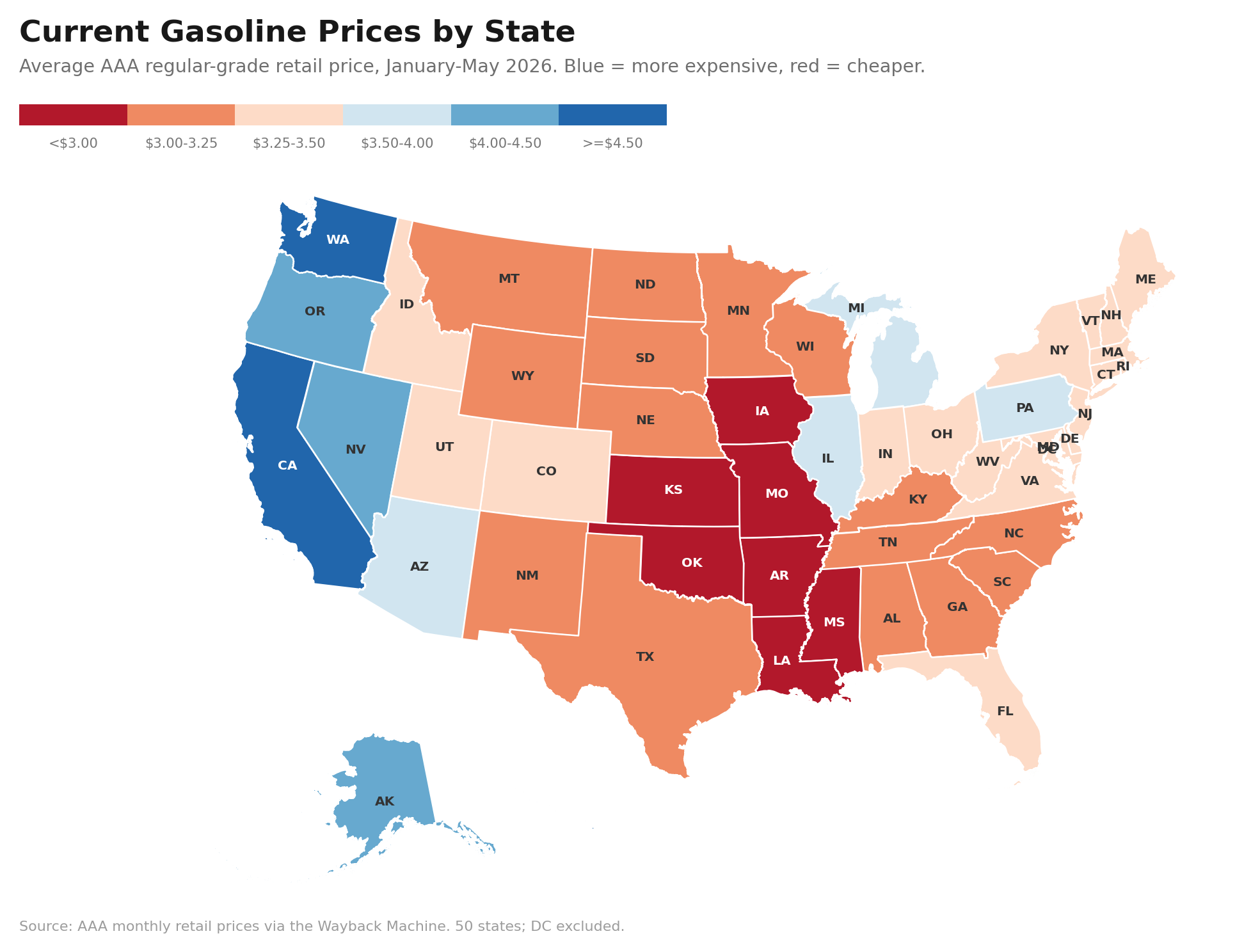
Five-year change in gasoline prices, January–May 2021 to January–May 2026. Blue = larger increase.
Conclusion
Democratic-controlled states have higher gasoline prices, and over the past five years, prices have risen faster there. Both gaps are real. But neither is well described as only an effect of today’s party label. About two-thirds of the price-level gap traces to identifiable policy and geography: state gasoline taxes, the West Coast refining region, California-specific fuel costs, and federal fuel rules. What remains is a small but statistically significant residual of about $0.13 per gallon. The faster five-year increase is mostly concentrated in states that already had high prices because of West Coast policy and supply geography—four Pacific states whose carbon-pricing programs and refinery losses arrived together in 2022 and 2023.
The political signal in gasoline prices is real, but it is a signal of accumulated policy choices: fuel taxes, carbon taxes, and regulatory environments built over decades, rather than of who happens to hold office right now. For policymakers, that is the actionable point: the levers that explain the gap are specific and identifiable, and the largest of them, state fuel taxes and transportation carbon taxes, pass through to consumers nearly dollar for dollar.